class: center, middle, inverse, title-slide .title[ # Diagnostic Test Results ] .subtitle[ ## How To Think - Session 2 ] .author[ ### Fernando Alvear ] .institute[ ### University of Missouri ] .date[ ### Jan 20 ] --- class: center, middle background-image: url('assets/leo-messi-mate.jpeg') background-size: contain --- # Machines, widgets, and time Question 2: If it takes 5 machines 5 minutes to make 5 widgets, how long would it take 100 machines to make 100 widgets? a. 1 minute b. 5 minutes c. 10 minutes d. 100 minutes - What is the correct answer? Why? - What percentage of students got it right? -- > Correct answer: <mark>b. 5 minutes</mark> -- - Let's think about how much time it takes for a single machine to make one widget... - Since 5 machines make 5 widgets in 5 minutes, then 1 machine makes 1 widget in... 5 minutes! - Thus, a single machine takes 5 minutes to make a widget. Importantly, the number of machines doesn't affect production time. - If we have 100 machines, then they would make each 1 widget in 5 minutes, for a total of 100 widgets. --- ## Question 2 results 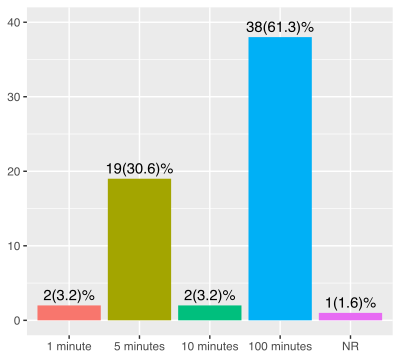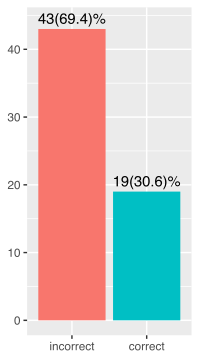 Why most people answered "100 minutes"? --- ## Question 2 results Why most people answered "100 minutes"? - We seem to answer this question by completing patterns, which sometimes lead us to the right answer. - What does this say? > I cnaont blveiee taht you can aulaclty uesdnatnrd waht tihs setnnece syas. - In the case of the widget production and widget time, the pattern leads to the wrong answer. --- # Lake and lily pads Question 3: In a lake, there is a patch of lily pads. Every day, the patch doubles in size. If it takes 48 days for the patch to cover the entire lake, how long would it take for the patch to cover half of the lake? a. 24 days b. 1 day c. 47 days d. 30 days - What is the correct answer? Why? - What percentage of students got it right? -- > Correct answer: <mark>c. 47 days</mark> -- - Remember that the patch doubles in size every day. - Imagine that _today_ the lake is finally covered in lily pads. Today is, then, day 48. - When was the lake covered only half of the way? Yesterday, which was day 47. --- # Question 3 results <img src="assets/q3-results.svg" width="70%" /> Why most people answered "24 days"? --- # Bat and ball Question 8: A bat and a ball cost $1.10 in total. The bat costs $1.00 more than the ball. How much does the ball cost? a. 10 cents b. 5 cents c. 1 cent d. 11 cents - What is the correct answer? Why? - What percentage of students got it right? -- > Correct answer: <mark>b. 5 cents</mark> -- - The ball and bat together cost $ 1.10 - bat + ball = 1.1 - The bat costs $1.00 more than the ball - bat = ball + 1 - Replace 'bat' in the first equation with the second - (ball + 1) + ball = 1.1 - 2 * ball = 0.1 - ball = 0.1 / 2 = 0.05 , or 5 cents. --- # Question 8 results <img src="assets/q8-results.svg" width="65%" /> Why most people answered "10 cents"? --- # World's deadliest animal? Question 5: What is the world’s deadliest animal? a. Snake b. Mosquito c. Dogs/wolves d. Squirrel e. Shark - What is the correct answer? Why? - What percentage of students got it right? -- > Correct answer: <mark>b. Mosquito</mark> --- # Question 5 results Results: <img src="assets/q5-results.svg" width="80%" /> --- # Impressions regarding Alan How favorable is your impression of Alan? There were two versions of this question. Version 1: > Alan is intelligent, industrious, impulsive, critical, stubborn, and envious. Version 2: > Alan is envious, stubborn, critical, impulsive, industrious, and intelligent. - Which version of Alan received better favorability ratings? - Average rating of version 1? (1 to 7) - Average rating of version 2? (1 to 7) --- # Question 1 results Results don't show any significant difference. 🤷🏻♂️ t = 0.062132, df = 58.713, p-value = 0.9507 <img src="assets/q1-results.svg" width="100%" /> --- # Disease X and test Question 4: Among people with no symptoms, one person has Disease X for every thousand people who don’t. There is a test for this disease that always gives a positive result when someone has the disease, but also does so 5 percent of the time when someone does not have the disease. A random person (let’s call it Mary) with no symptoms is tested and gets a positive result. What’s the probability of Mary having the disease? a. Less than 2% b. Between 2% and 10% c. Between 10% and 50% d. More than 50%, but less than 90% e. More than 90% - What is the correct answer? Why? - What percentage of students got it right? -- Answer: 1.96%, so the right answer is <mark>a. Less than 2%</mark>. --- # Disease X and test Why the probability that Mary has the disease so low, given that she tested positive? -- - Suppose Mary is one of 1001 individuals who get tested, 1000 of them don't have the disease, 1 has it. - How many of them will get a positive test result? - The one person who has the disease will definitely get a positive result. - Since the test gives a positive result 5% of the time when there's no disease present, out of the 1000 people who don't have the disease, 50 people (5%) will get a positive test result. - So, given that Mary tested positive, she is one of 51 people who tested positive. 1 / 51 = 0.0196, or 1.96%. --- # Question 4 results <img src="assets/q4-results.svg" width="100%" /> --- # Disease X and test Does this mean that tests are unreliable? -- - The problem is that **Mary doesn't have symptoms**, and that the presence of the disease is very low among those individuals (1 out of 1000). - The presence of the disease should be much higher among people _with_ symptoms. - 1 in 20? 1 in 10? - If the prevalence of the disease is 1 in 10, with a positive test result, the probability of having the disease is 66.67% - This is why doctors recommend to get tested again if you don't have symptoms. - Suppose Mary gets tested again, and once more, the test comes back positive. Then she has a 29% chance of having the disease. - If Mary gets a third positive result, then she would have a 88.89% chance of having the disease. --- # Apples and orange Question 10: Two bags are placed on a table. One contains two apples, and the other contains one apple and one orange. You have no idea which bag is which. You reach into one, and grab something at random. It’s an apple. Now what’s the probability that the bag you reached into has an orange in it? a. 0% b. 33.33% c. 50% d. 66.66% e. 100% - What is the correct answer? Why? - What percentage of students got it right? -- > Correct answer: <mark>b. 33.33%</mark>. -- - Before reaching into a bag, there's 50% change of reaching into the bag that has the orange. - The fact that you took an apple from the bag is _more probable_ if the bag you reached into had two apples instead of one. --- # Question 10 results <img src="assets/q10-results.svg" width="100%" /> --- # Linda the bank teller Question 9: Linda is 31 years old, single, outspoken, and very bright. She majored in philosophy. As a student, she was deeply concerned with issues of discrimination and social justice, and also participated in anti-nuclear demonstrations. Which is more probable? a. Linda is a bank teller. b. Linda is a bank teller and is active in the feminist movement. - What is the correct answer? Why? - What percentage of students got it right? -- > Correct answer: It's much more probable that <mark>a. Linda is a bank teller</mark>. -- - There are more _bank tellers_ than _bank tellers who are also active in the feminist movement_. - Imagine a random positive whole number. What is more probable? - The number is lower than 100 - The number is lower than 90 - Since the first alternative _includes the second alternative_, it's more probable. --- # Question 9 results <img src="assets/q9-results.svg" width="90%" /> --- # Coin flip Question 7: The probability that a fair coin will come up heads ten times in ten flips is very low: around 0.098% . Suppose that a fair coin has been flipped nine times and has come up heads every time, what is the probability that it will come up heads on the tenth flip? a. 0.098% b. 10% c. 50% d. 98% - What is the correct answer? Why? - What percentage of students got it right? -- Correct answer: <mark>c. 50%</mark>. -- - The probability that the coin will come up heads doesn't change over time. - The fact that the coin has come up heads nine times does not affect the chances of the tenth flip. --- # Question 7 results <img src="assets/q7-results.svg" width="90%" />